

Covid-19 and the digital divide 50-70yr olds
How did the pandemic effect the digital experiences of older adults (50-70) and organisations supporting them?
Covid-19 and the digital divide 50-70yr olds Read Post »
How did the pandemic effect the digital experiences of older adults (50-70) and organisations supporting them?
Covid-19 and the digital divide 50-70yr olds Read Post »
Tech4Teachers white paper based on the innovative ‘proof of concept’ project to provide teachers with laptops and digital skills.
Tech4Teachers White Paper Read Post »

Prepared by Deloitte for the DPA, this report will help improve the wider public’s understanding of digital poverty.

The role and importance of digital technologies for supporting learning in educational settings has been clearly identified such that “learning facilitated and supported by digital technologies, is seen as an essential part of formal education” (Harju et al., 2019, p. 388). The use of digital technology in school affords learners with a range of learning opportunities and can support their development (Mädamürk et al., 2021). Digital technology also can “diversify and enrich teaching in schools” (Harju et al., 2019, p. 389). However, it is important to acknowledge that while digital technology can support learning, it can also provide opportunities to avoid learning activities with the impact of digital technology yielding small but heterogenous results for academic functioning (Hietajärvi er al., 2022).
Tech4Schools Evaluation Read Post »

Ofcom regularly monitors people’s experience of communications services. This summary sets out the findings from our latest research into the affordability of home broadband, mobile phone, landline and pay-TV services.
Ofcom communications affordability tracker Read Post »

How can we include vulnerable populations in the digital domain and make sense of their cultural and social specificities?

The Digital Cooperation Organization (DCO) launched the Bridging the Gap Report, highlighting the need for greater international, multilateral cooperation to close the digital divide and ensure all nations can benefit from digital economies.

This paper explores Digital Poverty (DP) in England by adopting the DP Alliance’s theoretical framework
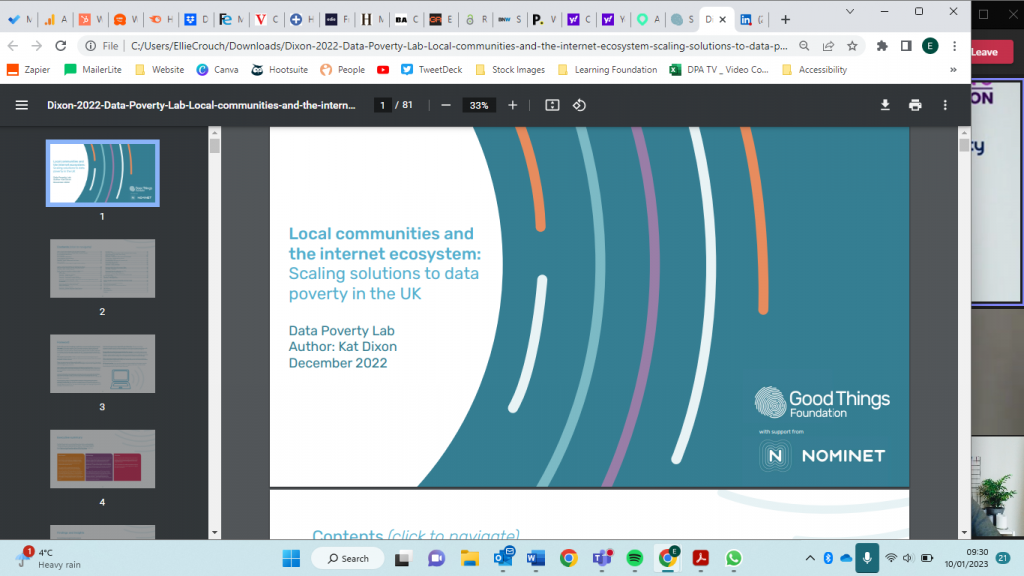
Written by Data Poverty Lab Fellow, Kat Dixon, this report invites us to question the internet’s role in society, the potential for future technologies, and the necessity of community design of the web.

As digital technology has become increasingly integrated with modern life, the ability to digitally engage has become more and more essential to interacting fully with society and the economy.
Understanding Digital Poverty and Inequality in the UK Read Post »

As every aspect of life – from job seeking to health care – moves online,
digital connectivity is a daily necessity, not a luxury. Against the
backdrop of the UK’s worst cost of living crisis in 40 years, discussions
about fuel and food poverty are now joined by a new concern with
what has become known as digital poverty – challenges affording
the cost of online connectivity and devices.
Digital Poverty in the UK Read Post »
This report is a landscape review of the qualitative and quantitative evidence around digital poverty, digital inequality, and digital exclusion/inclusion that has emerged in roughly the last decade.
UK Digital Poverty Evidence Review 2022 Read Post »